Download the Conference Proceedings
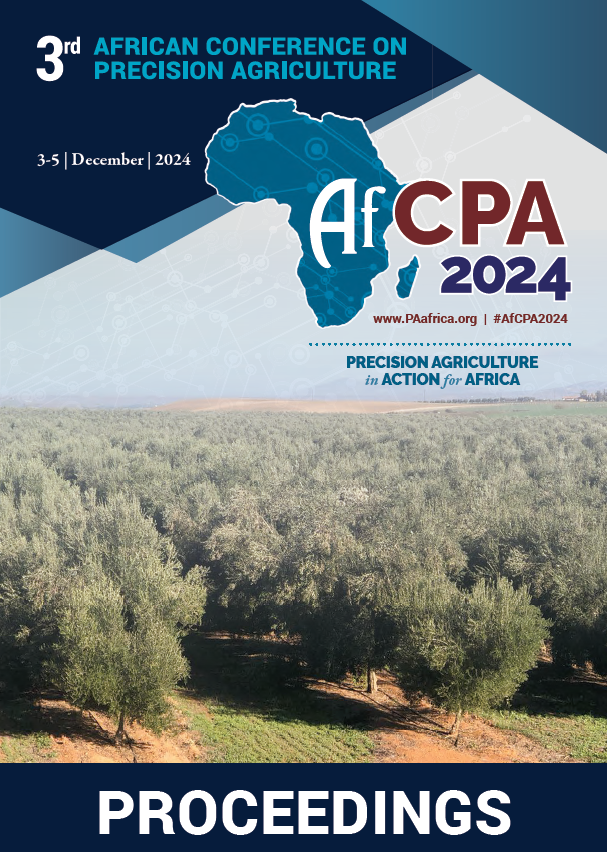
Proceedings
Authors
| Filter results5 paper(s) found. |
|---|
1. Decision Support System for Precision Agriculture management Case study : El Salihiya –east Nile delta, Egypt.Soil is a complex mixture of living organisms and organic material, along with soil minerals. the main objective of this work is develop a new methods to improve the agricultural management .The current study relies on developing a decision-making model for agricultural operations to manage potato crops in the El Salihiya area using field data,laboratory analysis and field sensor measurements. The precision agriculture decision support system entitled (EGYPADS) was designed and developed... A. Belal , S. Abd El-kader, B. Mamdouh , M. A El-shirbeny, M. Abdellatif1, M. Jalhoum , M. Zahran, E.S. Mohamed |
2. Irrigation Water Management for Potato crop under Pivot Irrigation System using Remote sensing techniquesWhen water application records low efficiency, the water losses increased. Irrigation systems often ignore soil variability and water applied uniformly on the field; hence, the water losses amplified. Which means more water application, more energy demand, and more money expenses. El-Salhia region contains a big agricultural farm located at the South Eastern of Nile delta. The field NO 34 was chosen to be investigated under the pivot central sprinkler irrigation system which cultivated with... |
3. Chlorophyll Meter Based Precision Nitrogen Management in Maize Grown in Alluvial Soil in EgyptPrecision nitrogen (N) management is essential for profitable crop production and to minimize N losses to the environment that are a consequence of an excessive N supply. Chlorophyll meter-based N management can help to achieve high N use efficiency, as aquick and non-destructive spectral characteristics of leaves, which can be used to diagnose plant N deficiency and graduate N fertilization with improve N use efficiency. Field experiments were conducted during two consecutive years, 2019 and... A. Soaud, S. Abou-zeid , A. Ali, D. Hassan |
4. Performance of Remote Sensing Data and Machine Learning for Wheat Disease DetectionThe use of agrochemicals has many impacts on humans’ health and generates many environmental issues. However, a suitable management of agrochemicals inputs, such as insecticides, fungicides, and herbicides, is crucial to the success of wheat crops under climate change conditions. The use of remote sensing technologies in agriculture was raised within the technological evolution of materials and techniques during last decades. The development of new and cheap sensors has been the main reason... Y. Lebrini, A. Ayerdi-gotor |
5. Optimizing Durum Wheat Nitrogen Nutrition Index (NNI) Prediction Through Sentinel-2 Vegetation Index IntegrationNitrogen is crucial for durum wheat growth and productivity, but excess or insufficient levels can harm both the environment and farmers' finances. Remote sensing offers rapid, cost-effective, and nondestructive ways to assess crop nutrition, with vegetation indices (VIs) indicating plant health. This study aims to enhance the accuracy of durum wheat nitrogen status prediction by investigating modified formulations of Nitrogen Nutrition Index (NNI) coupled with various vegetation indices (VIs),... N. Boughattas, K. Marwa, Z. Mohamed, A. Sawsen, A. Soumaya, H. Hafedh, H. Imen, T. Youssef |