Download the Conference Proceedings
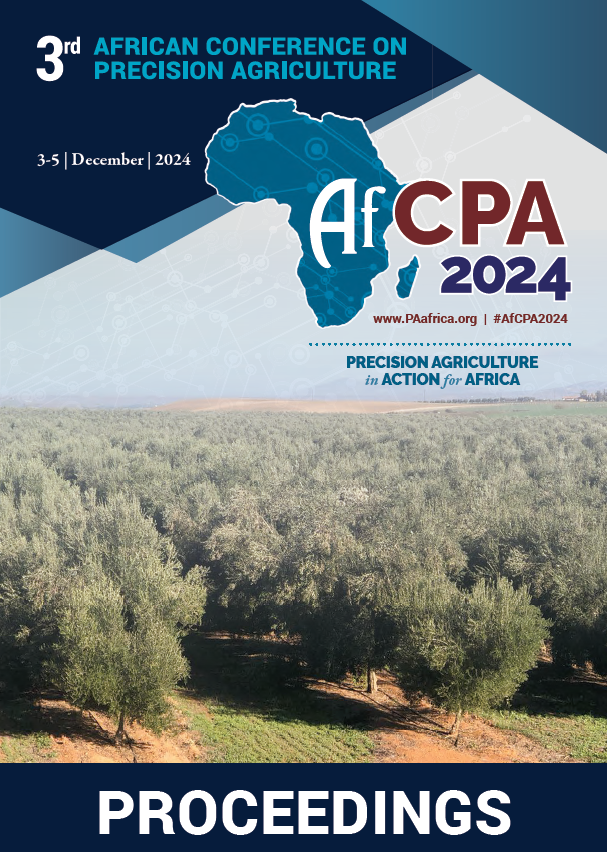
Proceedings
Authors
| Filter results17 paper(s) found. |
|---|
1. Excellence in Agronomy 2030: A new CGIAR-wide initiative to deliver agronomy solutions at scaleRequired increases in crop production and productivity in sub-Saharan Africa (SSA) will not happen without the increased use of appropriate agronomic practices. While several thousand new varieties of nearly all key crops have been produced in the past decade, recent increases in yields in specific countries have only happened when such varieties received the right agro-inputs and management. That said, agronomy is often highlighted as an area that has not delivered impact at scale in SSA, or... B. Vanlauwe, T. Amede, F. Baudron, P. Chivenge, M. Devare, K. Saito, J. Kihara, V. Nangia, P. Pypers, K. Shepherd, E. Vandamme |
2. Preparation of a precision ripping plan using manual vertical penetrometer measurementsLarge weight power engines and tools used in agriculture significantly contribute to the formation of compacted and thickening layers starting from the soil surface. There are suitable deep ripping technologies to eliminate harmful soil compaction, which are extremely energy and cost demanding. In precision agriculture, it is possible to treat spatially delimited unfavourable soil patches. The bulk density (g/cm3) of the soil was calculated from the soil resistance and moisture content... T. Rátonyi, P. Ragán, A. Széles, P. Fejér, E. Harsányi, I. Bácskai |
3. A cheap alternative to data management and creating of yield maps of small-plot field experimentsLong-term field trials provide an opportunity to examine the long-term effects of crop production factors and the effect of different crop years can also be analysed. In the long-term field trial, spatial representation of the data belonging to each plot might be necessary for the purpose of soil heterogeneity analysis, working hypothesis, or even presentation. Researchers dealing with long-term field trials usually store the measurement data for a given experiment in Excel or in a database of... P. Ragán, T. Rátonyi, A. Széles, P. Fejér, I. Bácskai, E. Harsányi |
4. Soil mapping with the VERIS U3 soil scanner in a precision farm in HungaryCurrently, field crop production faces constant challenges. Extreme climatic conditions, deteriorating circumstances on the field have a negative impact on the quantity and quality of available yields, and the ever-changing agro-economic environment makes the profitability of the sector uncertain. Precision crop production means site-specific agricultural cultivation tied to geographical coordinates. Modern strip tillage technology based on precision technology for crops with wide row spacing... P. Ragán, E. Harsányi, T. Rátonyi, A. Széles, P. Fejér, I. Bácskai |
5. Cashew Trees Detection and Yield Analysis using UAV-based MapIn this study we developed a novel method to detect cashew trees in an orthophoto map derived from images collected by an unmanned aerial vehicle (UAV). We also suggest a way in which these detections can be used to analyse the yield of the cashew farm. The proposed method uses images analysis to find the tops of trees, to merge different tops located on the same tree, and to segment individual tree. The segmented trees are used in a deep learning framework to know the exact location of cashew... T. Bayala, I. Ouattara, A. Visala, S. Malo |
6. Using Site-Specific Management Zones for Potato Crop Management, East Nile Delta, EgyptThe field management zones (MZ) delineated using soil electrical conductivity (EC) and topographic parameters are the basis for site-specific crop management (SSCM). The objective of this paper was to delineation site-specific management zones of 155 feddans (67.2 ha) of a potato pivot field at East of Nile Delta, Egypt for use in smart farming based on spatial variability of soil and plant properties, yield and topographic attributes. The salinity measurement in the field... A.B. Belal, E.S. Mohamed, M.E. Jalhoum, M. Zahran, M.A. Abdellatif, M.S. Emam, E.A. Hendway |
7. Evaluation of on –farm oil palm yield parameters in Niger Delta region of NigeriaEvaluation of on –farm oil palm yield parameters in Niger Delta region of Nigeria *Ekhator F1., Osayande P1., Aduramigba-Modupe V.O2., Solomon O1., and Ikuenobe C.E1. 1Nigerian Institute for Oil Palm Research (NIFOR) P.M.B 1030, Benin City, Edo State 2Institute of Agricultural Research and Training, Obafemi Awolowo University, Ibadan, Oyo... E.C. Ikuenobe, K.D. Madukwe, F. Ekhator, V.M. Aduramigba, P.E. Osayande, S. Solomon, N.M. Okoye |
8. LiDAR-based soybean crop segmentation for autonomous navigationThe technological advances in the last few decades have greatly changed agricultural operations. In order to became safer, more profitable, efficient, and sustainable, modern farms have adopted the use of sophisticated technologies, such as robots, sensors, aerial images, and GNSS (Global Navigation Satellite System). These technologies not only increase the crop productivity, but also reduce the wide use of water, fertilisers, and pesticides. Due to this, they reduce costs and negative environmental... V.A. Higuti, A.E. Velasquez, M.V. Gasparino, D.V. Magalhães, M. Becker, D.M. Milori, R.V. Aroca |
9. DIGITAL MAPPING OF EXCHANGEABLE CATIONS IN SOILS OF SOUTHWESTERN NIGERIASoil acidity and low exchangeable cation are the major soil fertility challenges resulting in low crop productivity in Southwest Nigeria. Digital soil mapping is an effective way to achieve precision agriculture. However, most of the research work on soil exchangeable cations as soil information was not geo-referenced, The study created geo-database and developed a digitized map of soil exchangeable cations Indicating the spatial distribution in soils of southwestern Nigeria. Secondary data... O.E. Awosiyan, I.K. Mary, F.A. Adesina |
10. Determinants of the adoption of an intelligent monitoring system and effects on farms performance in TunisiaConcidering the observation of the rise of Computerized Management Software Packages and intelligent monitoring in a path of modernization of agricultural techniques, we questioned the main factors influencing the decision to adopt management software, farmers’ perception of these management tools and their impact on farm performance. Referring to a theoretical framework focused on innovation and the adoption of technologies in agriculture, we triggered the hypothesis of research... J. Ben Nasr, H. Chiboub, M. Msaddak |
11. Using Decision Support Tool for Site Specific Nutrient Management in Maize Production in Ethiopia: The case of Nutrient ExpertThere are huge variabilities among farmers in terms of crop management practices, soil types and fertility status as well as climatic conditions all of which affects crop fertilizer requirement and yield. Despite these variations, farmers are using blanket/regional fertilizer recommendations, which does not consider the above-mentioned variabilities. As a consequence, farmers are either practicing over fertilization or under fertilization, both of which have undesirable consequences. Therefore,... T. Balemi |
12. Fighting Food, Fertilizer, and the Climate Crisis in Africa Through Targeted Nitrogen ManagementFood insecurity is a major challenge in Africa which is likely to worsen in the future unless food production in the region is substantially increased to keep up with the food demand of the increasing population. A sufficient amount of nitrogen (N) fertilizer is required for increasing crop yield as N helps convert solar radiation into carbohydrates that drive plant growth. However, smallholder producers in Africa use a small quantity of fertilizer N not sufficient for plant needs resulting... T. Sapkota, N. Cheerakkollil Konath, R. Takele, S. Snapp |
13. Lime and Phosphorus Effects on Soil Acidity and Malt Barley Phosphorus Use Efficiency in Welmera District, Central Highlands of EthiopiaIn Ethiopia, about 43% of total arable land affected by soil acidity. Furthermore, phosphorus (P) deficiency is a major constraint to increase crop yields. Efforts to ameliorate the deleterious effects of soil acidity must therefore be accompanied by measures to increase P availability in soils. Therefore, appropriate rate of lime and P fertilizer is an important strategy for improving crop growth in acidic soils. Accordingly, an experiment was undertaken to study lime and P effects on soil acidity... N.T. Geremew, B.B. Waraka, L.W. Mirkena |
14. Maximisation De L’efficience D’utilisation Des Nutriments : Recommandation De Fertilisation à La Carte Pour Le Maïs Sur Les Ferralsols Du Sud-togoL'amélioration de la nutrition des plantes à travers l'agriculture de précision devient incontournable pour l'optimisation de l'entreprise agricole et la protection de l'environnement. Nous avons conduit pendant la grande saison culturelle de 2019 et 2020, sous culture de maïs (Zea mays L.), des essais soustractifs à base de l'azote (N), du phosphore (P) et du potassium (K) à la station d'expérimentations agronomiques (SEAL)... J. Sogbedji, L. William, M. Lare, A. Sekaya, K. Sika , E. Tagba |
15. Sustainability of Maize Production with Farmers’ Practices and Redesigned Crop Management Practices in CRV and Jimma of EthiopiaMulti-criteria assessment of crop management practices is vital for sustainable crop production and environmental safety. In this study, sustainability of maize production with farmer’s practice (FP), redesigned plant density plus current fertilizer use (RDCF), current plant density plus redesigned fertilizer use (CDRF), and redesigned plant density and redesigned fertilizer use (RDRF) were assessed at farm level based on social, agronomic, economic and environmental principles in Central... W. Kenea, A.N. Woldekristos, T. Balemi |
16. Capacity Building of African Young Scientists in Precision Agriculture Through Cross Regional Academic MobilityClimate change is one of the main problems affecting food and nutrition globally, particularly in sub-Saharan Africa. Adapting to and/or mitigating climate change in the agri-food sector requires merging information technologies, genetic innovations, and sustainable farming practices to empower the agricultural youth sector to create effective and locally adapted solutions. Precision Agriculture applied to crops (PAAC), has been advocated as a strategic solution to mitigate/adapt agriculture at... K. Frimpong, V. Fassinou Hotegni, A. Karangwa, A. Manyatsi, M. Amri, D. Cammarano, C. Lesueur, J. Taylor, S. Phillips, E.G. Achigan-dako, G. Houessou, O. Linkpon, D. Tchokponhoué, C. Houdegbe, C. Adje |
17. Predicting the Distribution of Groundnut Phytopathogens Under Current and Future Climatic Scenarios in ZimbabweGroundnut (Arachis hypogaea L.) is an important oil crop with immense nutritional and economic benefits, but its productivity in sub-Saharan Africa (SSA) is threatened by a plethora of phytopathogens such as groundnut rosette virus, Alternaria leafspots, early leafspots and peanut rust. In Zimbabwe, ecological niches and epidemiology of these pathogenic microbial strains, particularly under the current and predicted climate change scenarios, are still poorly understood. Yet, this information... H. Chinwa, C.N. Kamutando |