Download the Conference Proceedings
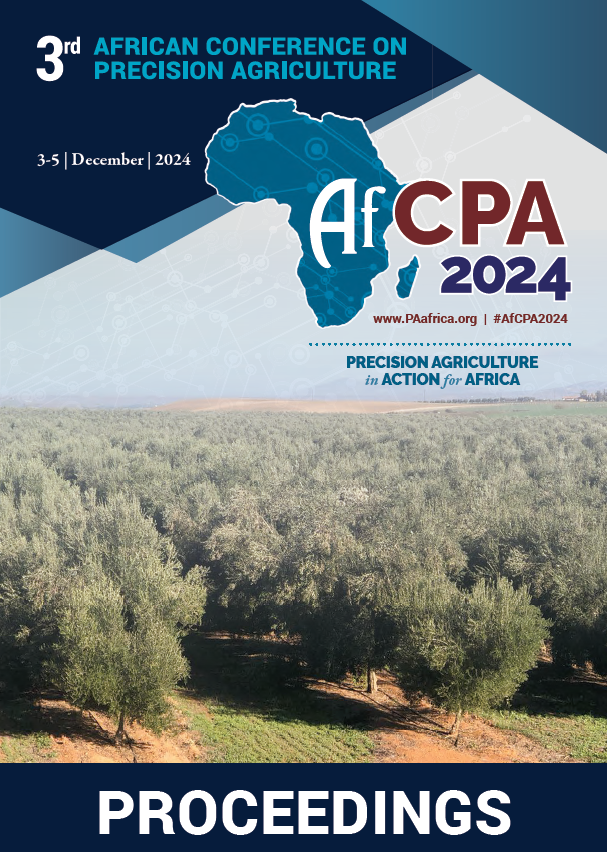
 
Get your copy of the 2024 African Conference on Precision Agriculture Proceedings today! Download the PDF file and view all of the available proceedings.
AfPCA Proceedings 2024

Proceedings

Find matching any: Reset
LEBRINI, Y
Shephard, K
Sibanda, M
LEE, J
Landolsi, M
Scott, B
SOGBEDJI, M.J
SOGBEDJI, J
Lutomia, C
Pypers, P
Phillips, S
Add filter to result:
Authors
Vanlauwe, B
Amede, T
Baudron, F
Chivenge, P
Devare, M
Saito, K
Kihara, J
Nangia, V
Pypers, P
Shepherd, K
Vandamme, E
LARE, M
SOGBEDJI, M.J
MORIMOTO, E
LEE, J
NONAMI, K
MATUMURA, I
IKEBE, M
SATO, S
WILLIAM, K
SOGBEDJI, J
LARE, M
Aduramigba-Modupe, V
Amapu, I
Walsh, M
Scott, B
Crouch, J
Shephard, K
Miller, M
Collinson, J
Singh, P
Pypers, P
van den Bosch, R
van Beek, C
Chernet, M
Aston, S
van Beek, C
Chernet, M
Aston, S
Miller, M
Collinson, J
Shephard, K
Crouch, J
Terhoeven-Urselmans, T
LEBRINI, Y
AYERDI-GOTOR, A
LARE, M
SOGBEDJI, J
LOTSI, K
AMOUZOU, K
ALE GONH-GOH, A
AGNEROH , A
SOGBEDJI, J
LARE, M
SOGBEDJI, J
WILLIAM, L
LARE, M
SEKAYA, A
SIKA , K
TAGBA, E
Sibanda, M
Adolwa, I
Muthamia, J
Lutomia, C
Cook, S
Topics
Decision Support Systems
Precision Agriculture for Field and Plantation Crops
Precision Nutrient Management
Plenary
Proximal and Remote Sensing
Economics of Precision Agriculture
Adoption of Precision Agriculture
Robotics, Automation, and Small Farm Mechanization
On-Farm Experimentation
Type
Oral
Year
2020
2022
2024
Home » Authors » Results

Authors

Filter results13 paper(s) found.

1. Excellence in Agronomy 2030: A new CGIAR-wide initiative to deliver agronomy solutions at scale

Required increases in crop production and productivity in sub-Saharan Africa (SSA) will not happen without the increased use of appropriate agronomic practices. While several thousand new varieties of nearly all key crops have been produced in the past decade, recent increases in yields in specific countries have only happened when such varieties received the right agro-inputs and management. That said, agronomy is often highlighted as an area that has not delivered impact at scale in SSA, or... B. Vanlauwe, T. Amede, F. Baudron, P. Chivenge, M. Devare, K. Saito, J. Kihara, V. Nangia, P. Pypers, K. Shepherd, E. Vandamme

2. Maximisation de l’efficience d’utilisation de l’azote par la tomate(Solanum lycopersicum L.) sur les ferrasols au Sud du Togo

Maximiser l'efficience d'utilisation de l'Azote (N) en culture de tomate s'impose pour améliorer le rendement et la rentabilité de la culture. Il a été mené sur trois ans, six cultures de tomate réparties sur deux périodes (septembre à janvier 2017-2019 et de février à mai 2018-2020) sur un sol ferralitique à la Station d'Expérimentations Agronomiques de Lomé suivant un dispositif expérimental... M. Lare, M.J. Sogbedji

3. Development of Canopy Mapping System of Asian pears (Pyrus pyrifolia Naka) Using Terrestrial Laser Scanning

In this paper, the canopy mapping system (CMS) of Asian pears for estimating yield during Bud thinning and Pruning operations using point cloud data was proposed. Bud thinning and Pruning in Asian pear (Pyrus pyrifolia Naka) is necessary to ensure quality and yield but is time-consuming and heavily depends on work knowledge. This study described a method of estimating the number of fruits through the length of a branch based on remote sensing. The CMS would be useful to support more efficient... E. Morimoto, J. Lee, K. Nonami, I. Matumura, M. Ikebe, S. Sato

4. La fertilité indigène du sol : un élément catalyseur de l’agriculture de précision

Dans le contexte actuel de la dégradation des ressources naturelles et des problèmes de disponibilité et d'accessibilité des intrants agricoles, l'agriculture de précision dont le point d'entrée est la connaissance de la fertilité endogène du sol s'impose. Des essais soustractifs ont été conduits pendant deux ans (2018-2019) à la Station d'Expérimentations Agronomiques de l'Université... K. William, J. Sogbedji, M. Lare

5. Methodology for Assessing Nutrient Status of Nigeria Croplands: AfSIS/NiSIS Pilot Project - Pathway for Precision Agriculture Mapping

Inherently low soil fertility, nutrient imbalances and accelerating degradation constitute threats to precision agriculture (PA), agricultural productivity and ecosystem services in sub-Saharan Africa (Nigeria inclusive). Presently, the geographical extent of existing nutrient constraints, location specific trends and opportunities for managing these over time are highly uncertain. The AfSIS/NiSIS project assessment aims to provide spatially explicit observations, measurements and predictions... V. Aduramigba-modupe, I. Amapu, M. Walsh, B. Scott

6. Mapping African soils at 30m resolution - iSDAsoil - Western Time Zones

“iSDAsoil” combines remote sensing data and other geospatial information with carefully stratified point samples subjected to spectral analysis and traditional wet chemistry reference analysis. State of the art machine learning techniques were used to create digital maps of 17 agronomically important soil properties at 3 depths, including estimates of uncertainty. iSDAsoil is designed to encourage sharing and we hope that the owners of other soil and agronomic data, in industry... J. Crouch, K. Shephard, M. Miller, J. Collinson, P. Singh, P. Pypers, R. Van den bosch, C. Van beek, M. Chernet, S. Aston

7. Mapping African soils at 30m resolution - iSDAsoil - Eastern Time Zones

“iSDAsoil” combines remote sensing data and other geospatial information with carefully stratified point samples subjected to spectral analysis and traditional wet chemistry reference analysis. State of the art machine learning techniques were used to create digital maps of 17 agronomically important soil properties at 3 depths, including estimates of uncertainty. iSDAsoil is designed to encourage sharing and we hope that the owners of other soil and agronomic data, in industry... C. Van beek, M. Chernet, S. Aston, M. Miller, J. Collinson, K. Shephard, J. Crouch, T. Terhoeven-urselmans

8. Performance of Remote Sensing Data and Machine Learning for Wheat Disease Detection

The use of agrochemicals has many impacts on humans’ health and generates many environmental issues. However, a suitable management of agrochemicals inputs, such as insecticides, fungicides, and herbicides, is crucial to the success of wheat crops under climate change conditions. The use of remote sensing technologies in agriculture was raised within the technological evolution of materials and techniques during last decades. The development of new and cheap sensors has been the main reason... Y. Lebrini, A. Ayerdi-gotor

9. Recommandation De Formules De Fertilisation Site-spécifique Pour La Production Du Maïs Dans La Région Des Savanes Du Togo

Dans le contexte actuel de la dégradation des terres agricoles et des difficultés de disponibilité et d'accès aux intrants agricoles en particulier les engrais, la maximisation de l'efficience d'utilisation des nutriments en nutrition des plantes devient plus que jamais une nécessité. Nous avons conduit en 2020 sous culture de maïs (Zea mays L.), des essais soustractifs à base de l'azote (N), du phosphore (P) et du potassium... M. Lare, J. Sogbedji, K. Lotsi, K. Amouzou, A. Ale gonh-goh, A. Agneroh

10. Variability in Yield Response of Maize to N, P and K Fertilization Towards Site-specific Nutrient Recommendations in Two Maize Belts in Togo

Les régions de savane et du centre sont les principales zones de production de maïs au Togo, mais avec des rendements en grains de maïs à un seuil de seulement 1,5 Mg ha -1 . Nous utilisons une approche participative pour évaluer l'importance des trois principaux macro-éléments (N, P et K) pour la culture du maïs dans les deux régions afin de permettre davantage de recommandations d'engrais spécifiques au site et... J. Sogbedji, M. Lare

11. Maximisation De L’efficience D’utilisation Des Nutriments : Recommandation De Fertilisation à La Carte Pour Le Maïs Sur Les Ferralsols Du Sud-togo

L'amélioration de la nutrition des plantes à travers l'agriculture de précision devient incontournable pour l'optimisation de l'entreprise agricole et la protection de l'environnement. Nous avons conduit pendant la grande saison culturelle de 2019 et 2020, sous culture de maïs (Zea mays L.), des essais soustractifs à base de l'azote (N), du phosphore (P) et du potassium (K) à la station d'expérimentations agronomiques (SEAL)... J. Sogbedji, L. William, M. Lare, A. Sekaya, K. Sika , E. Tagba

12. Detecting the Impact of Hail Damage on Maize Crops in Smallholder Farms Using Unmanned Aerial Vehicles Derived Multispectral Data

Natural disasters such as hailstorms are now frequent and negatively impact smallholder farmers' livelihoods. In these events, there is a need for robust and innovative techniques for monitoring the extent of their damage in smallholder croplands to optimise production. In this regard, this study sought to evaluate the utility of drone-derived multispectral data in estimating crop health elements (i.e., equivalent water thickness (EWT), chlorophyll content, and leaf area index (LAI) of maize... M. Sibanda

13. The Value and Potential of On-Farm Experimentation to Catalyze Agricultural Transformation

On-farm experimentation (OFE), which inculcates farmers’ agency in knowledge discovery, has the potential to support and accelerate transformative agronomy at scale. The OFE process within the Nutrient-Catalyzed Agricultural Transformation in Africa (NUTCAT) project, encompasses farmer engagements, set-up of simple, easy-to-understand treatment designs, and contextual analysis of the data to enhance the relevance of the results to farmers. Ultimately, it is envisaged that this process will... I. Adolwa, J. Muthamia, C. Lutomia, , S. Cook