Download the Conference Proceedings
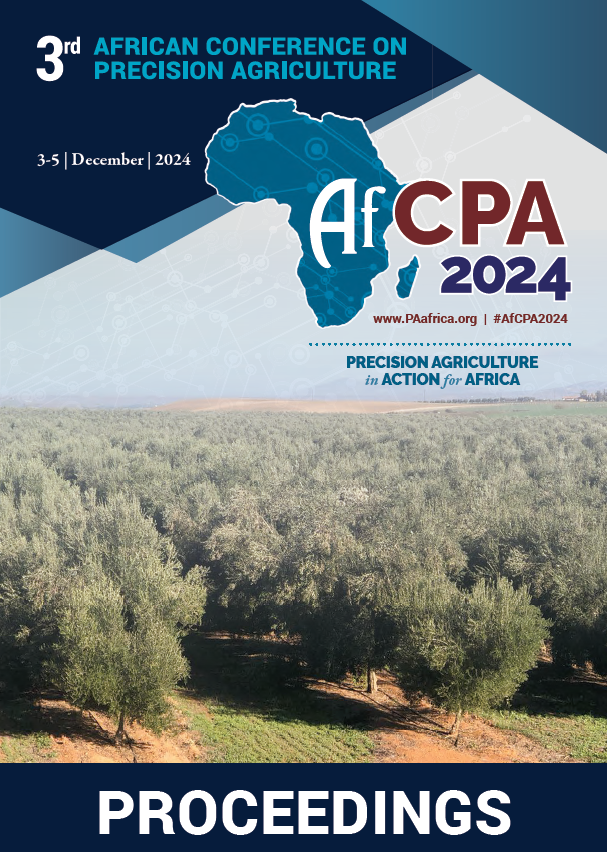
Proceedings
Authors
| Filter results20 paper(s) found. |
|---|
1. Mapping African soils at 30m resolution - iSDAsoil: leveraging spatial agronomy in farm-level advisory for smallholdersField level soil data has been the foundation of agronomic advisory, but traditional methods involving on-farm sampling are too expensive for a large proportion of African smallholders. Building on the work of the African Soil Information Service (AfSIS), Innovative Solutions for Decision Agriculture (iSDA) and partners have created an agronomic soil database which covers the entire African continent at a spatial resolution of 30 m. “iSDAsoil” combines remote sensing data and other... J. Crouch |
2. Preparation of a precision ripping plan using manual vertical penetrometer measurementsLarge weight power engines and tools used in agriculture significantly contribute to the formation of compacted and thickening layers starting from the soil surface. There are suitable deep ripping technologies to eliminate harmful soil compaction, which are extremely energy and cost demanding. In precision agriculture, it is possible to treat spatially delimited unfavourable soil patches. The bulk density (g/cm3) of the soil was calculated from the soil resistance and moisture content... T. Rátonyi, P. Ragán, A. Széles, P. Fejér, E. Harsányi, I. Bácskai |
3. A cheap alternative to data management and creating of yield maps of small-plot field experimentsLong-term field trials provide an opportunity to examine the long-term effects of crop production factors and the effect of different crop years can also be analysed. In the long-term field trial, spatial representation of the data belonging to each plot might be necessary for the purpose of soil heterogeneity analysis, working hypothesis, or even presentation. Researchers dealing with long-term field trials usually store the measurement data for a given experiment in Excel or in a database of... P. Ragán, T. Rátonyi, A. Széles, P. Fejér, I. Bácskai, E. Harsányi |
4. Soil mapping with the VERIS U3 soil scanner in a precision farm in HungaryCurrently, field crop production faces constant challenges. Extreme climatic conditions, deteriorating circumstances on the field have a negative impact on the quantity and quality of available yields, and the ever-changing agro-economic environment makes the profitability of the sector uncertain. Precision crop production means site-specific agricultural cultivation tied to geographical coordinates. Modern strip tillage technology based on precision technology for crops with wide row spacing... P. Ragán, E. Harsányi, T. Rátonyi, A. Széles, P. Fejér, I. Bácskai |
5. CropSAT – opportunities for applications in precision agriculture in AfricaThe present paper aims at describing the CropSAT system, a Sentinel-2-based interactive decision support system (DSS) that provides vegetation index (VI) maps free-of-charge all across the globe for different applications in precision agriculture. We summarize research results from the ongoing developmental process and pointing to opportunities for development and application in precision agriculture in Africa. The DSS was initially developed in a research project at the Swedish University of... O. Alshihabi, I. Nouiri, M. Mechri, H. Angar, K. Piikki, J. Martinsson, M. Söderström |
6. MAPPING AND ASSESSING AFRICAN SOILS FERTILITY USING HIGH-RESOLUTION REMOTE SENSING AND MACHINE LEARNING APPROACHES: STATE-OF-THE-ART AND PERSPECTIVESAfrica is far from exploiting its true agricultural potential. United Nations Food and Agriculture Organization (FAO) indicates that the continent has 60% of non-cultivated lands worldwide. While soil fertility is well highlighted as one of the major limiting factors, only limited information is available on soil nutrient contents and nutrient availability in the African soils. Soil fertility of agricultural fields is related to many physical and chemical properties, such as texture, organic matter... M. Hmimou, A. Laamrani, F. Sehbaoui, A. Chehbouni, S. Khabba, D. Dhiba |
7. A precision irrigation app for smart water management by farmersIn a context of climate change and water scarcity which is globally recognized, Morocco is one of the countries that are facing already insufficient water supply for irrigation in order to sustain productivity and food security. Therefore, there is a strong need for adapting agricultural practices and developing new technologies for efficient and smart irrigation management to make best use of available water and maximize productivity per unit of consumed water. Recent studies have shown that... A. Abouabdillah , R. Bouabid |
8. QUANTIFICATION OF OPTIMAL FERTILIZERS DEMAND IN WHEAT AND CORN FIELDS IN MOROCCO USING VERY HIGH-RESOLUTION REMOTE SENSED IMAGERY AND HYBRID COMPUTATIONAL APPROACHESAbstract. Demand on agricultural products is increasing as population continues to grow. Data driven management of macronutrients (i.e., nitrogen (N), phosphorus (P) and potassium (K)) and crops are of critical prominence to get the most out of soil in terms of crop yield while preserving environment. This study aims to establish a quantitative framework for macronutrient (i.e., nitrogen, phosphorus, and potassium) status (i.e., excess, deficiency) for winter wheat (Triticum aestivum... K. Misbah, A. Laamrani, A. Chehbouni , D. Dhiba , J. Ezzahar, K. Khechba |
9. Monitoring irrigation water use at large scale irrigated areas using remote sensing in water scarce environmentIncreasing pressure on available water resources in semi-arid region will affect the availability of water for irrigated agriculture. In this context, adoption of innovative and cost-effective tools for water management and analysis of water use patterns in irrigated areas is required for an efficient and sustainable use of water resources. This study aims to evaluate a remote sensing-based approach which allows estimation of the temporal and spatial distribution of crop evapotranspiration... M. Kharrou, V. Simonneaux, M. Le Page, S. Er-raki, G. Boulet, J. Ezzahar, S. Khabba, A. Chehbouni |
10. The status of precision agriculture and its adoption in MoroccoPrecision agriculture (PA), as an integrated crop management system that uses various tools and technologies for assessing and monitoring soil and crop spatial variability and for implementing site-specific (variable rate) applications, is a concept that becomes nowadays in many developed countries a common practice rather than an innovation. On the contrary, in most developing countries, agriculture is still struggling with the basics of farming and is constrained by many factors, such as land... R. Bouabid |
11. Comparison of soil testing and scanning methods for spatial variability assessment of soil fertility: implications for precision agricultureUnderstanding spatial variability of soil fertility is a key to variable rate nutrient applications for precision fertilization. The objective of this study was to assess field spatial variability of soil fertility using two approaches, a gridded soil testing and a scanner-based technique. Measurements were performed on a quarter pivot silage corn field of 13 ha. For the first approach, soil samples were taken on a geopositioned grid and were analyzed for the main physicochemical and nutrient... R. Bouabid |
12. Spatial variability of soil and tree nutrient status in relation to bitter pit incidence in apple orchards in the Sais plateau, MoroccoDiscreet spatial variability of soil fertility affects crop productivity and quality. In general, nutrient deficiencies are the most incriminated. However, excess or unbalanced nutrient can also impact seriously both yield and quality, especially in fruit tree crops. Bitter-pit, a nutrient disorder related to K-Ca-Mg unbalance in apple orchards can cause major loss of apple quality in field, as well as on post-harvest following periods of cold storage. Conventional composite sampling for soil... R. Bouabid |
13. Mapping African soils at 30m resolution - iSDAsoil - Western Time Zones“iSDAsoil” combines remote sensing data and other geospatial information with carefully stratified point samples subjected to spectral analysis and traditional wet chemistry reference analysis. State of the art machine learning techniques were used to create digital maps of 17 agronomically important soil properties at 3 depths, including estimates of uncertainty. iSDAsoil is designed to encourage sharing and we hope that the owners of other soil and agronomic data, in industry... J. Crouch, K. Shephard, M. Miller, J. Collinson, P. Singh, P. Pypers, R. Van Den Bosch, C. Van Beek, M. Chernet, S. Aston |
14. Mapping African soils at 30m resolution - iSDAsoil - Eastern Time Zones“iSDAsoil” combines remote sensing data and other geospatial information with carefully stratified point samples subjected to spectral analysis and traditional wet chemistry reference analysis. State of the art machine learning techniques were used to create digital maps of 17 agronomically important soil properties at 3 depths, including estimates of uncertainty. iSDAsoil is designed to encourage sharing and we hope that the owners of other soil and agronomic data, in industry... C. Van Beek, M. Chernet, S. Aston, M. Miller, J. Collinson, K. Shephard, J. Crouch, T. Terhoeven-urselmans |
15. Modelling Fertigation and Micro-Climate Parameters for Greenhouse Tomato (Solanum Lycopersicum L.)Amidst the hiking price of fertilizer and projected water scarcity across the world, it is imperative to explore the interaction between fertilizer, irrigation and genotype notwithstanding the micro-climate parameters so as to maximize yield while protecting the environment. The Decision Support System for Agrotechnology Transfer (DSSAT) is a model which employs all these input factors to help predict yield and thereby make an informed decision. The study sort to calibrate and validate the... Y.K. Agbemabiese, P. Abubakari, P.K. Dzomeku, I. Shaibu |
16. Use of Earth Observation Imagery, Advanced Modelling Algorithms and Other Monitoring Systems to Produce Operational Agricultural Annual Crop Inventories for Morocco.African farmers are facing the challenges of a changing climate, increased temperatures, changes in rainfall patterns, more frequent extreme weather events and reductions in water availability. The digital transformation of the agricultural sector is one of the opportunities that can promote good practices of the African agricultural through the sharing of information and tools for decision-making, thereby, boost economic growth of our African country. The shift to digital technologies is... M. Choukri, A. Laamrani , V. Simonneaux , B. Gerard , S. Belaqziz, A. Chehbouni, K. Misbah, H. Mcnairn |
17. Together, Let's Make Africa the Epicenter of a Sustainable Transformation of Food Systems... P. Bwire |
18. Implementing Field-Based High Throughput Plant Phenotyping: The Open Source Way... Y. Kassim |
19. Rainwater Harvesting and Nutrient Intensification in Maize-Legume Farming Systems in Semi-Arid ZimbabweAgricultural productivity in Zimbabwe is declining mainly due to climate change and inherently poor soil fertility. The situation is worsened by the high cost of fertilizers beyond the reach of many smallholder farmers. In response to these challenges, most smallholder farmers are implementing either rainwater harvesting (RWH) or integrated soil fertility management (ISFM). This study sought to investigate the role of integrating the tied-contour RWH (TC-RWH) technique and ISFM on soil moisture,... E. Mutsamba-magwaza, D. Nyamayevu, G. Nyamadzawo, R. Mandumbu, I. Nyagumbo |
20. High-Throughput Field Phenotyping of Ascochyta Blight Disease Severity in Chickpea Using Multispectral ImagingAscochyta blight (AB) caused by Ascochyta rabiei (Pass.) Labr. is an important and widespread disease of chickpea (Cicer arietinum L.) worldwide. The disease is particularly severe under cool and humid weather conditions, leading to crop losses at all stages of chickpea growth. Screening for resistant cultivars remains the most effective, economical and ecological method of disease management. However, traditional phenotyping methods that relying on trained experts are... F. Ibn El Mokhtar, S. Krimibencheqroun , , A. Harkani , H. Houmairi , O. Idrissi , E. Abdellah , E. Abdellah |