Download the Conference Proceedings
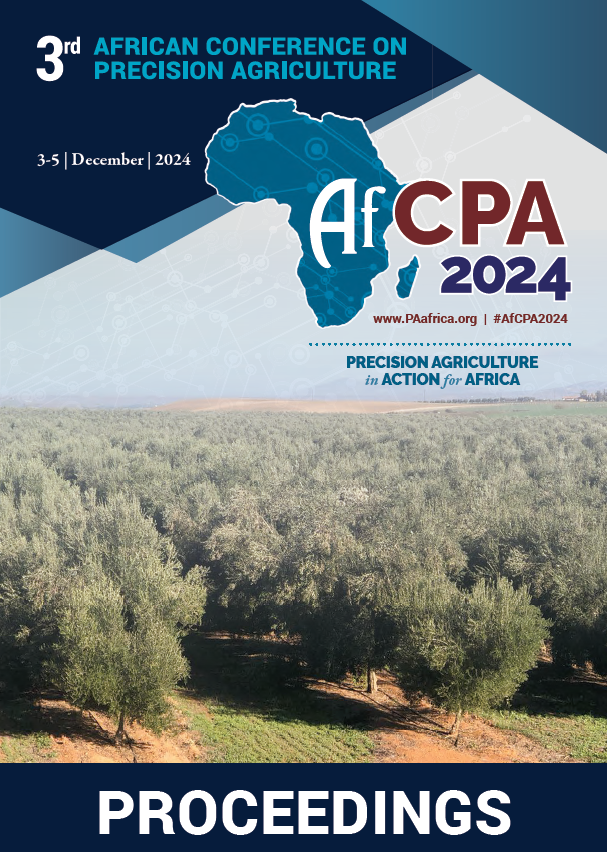
Proceedings
Authors
| Filter results12 paper(s) found. |
|---|
1. The Vision of Future Earth Observation for AgricultureThe main objective of EO4AGRI is to catalyze the evolution of the European capacity for improving operational agriculture monitoring from local to global levels based on information derived from Copernicus satellite observation data and through exploitation of associated geospatial and socio-economic information services. EO4AGRI assists the implementation of the EU Common Agricultural Policy (CAP) with special attention to the CAP2020 reform, to requirements of Paying Agencies, and... K. Charvat, V. Safar, H. Kubickova |
2. SmartAfriHub for SmartAgriculture capacity buidling in AfricaDigital Innovation Hubs (DIH) are multi-actor ecosystems that support farming communities in their digital transformation by providing a broad variety of services from a one-stop shop. DIHs purpose is to provide a social space for community of practices; provide access to digital technologies and competencies; provide access to infrastructure and tests digital innovations (“test before invest”); provide development playground... K. Charvat, C. Miderho , A. Obot, T. Löytty, H. Kubickova |
3. Tomato yield and economic performance under organic and mineral fertilizer applications in coastal TogoResearch efforts towards enhancing vegetables production are still needed in Togo. We assessed tomato (Solanum lycopersicum) yield and associated economic returns under three soil fertility management strategies in a 3-yr period study. Three tomato varieties were used including: MONGAL-F1 (V1), SUMO-F1 (V2) and COBRA 26-F1 (V3). The fertilization regimes were: no fertilizer application as the control (F1), application of 200 kg of N15P15K15 + 100... J.M. Sogbedji, M. Lare |
4. Development of Canopy Mapping System of Asian pears (Pyrus pyrifolia Naka) Using Terrestrial Laser ScanningIn this paper, the canopy mapping system (CMS) of Asian pears for estimating yield during Bud thinning and Pruning operations using point cloud data was proposed. Bud thinning and Pruning in Asian pear (Pyrus pyrifolia Naka) is necessary to ensure quality and yield but is time-consuming and heavily depends on work knowledge. This study described a method of estimating the number of fruits through the length of a branch based on remote sensing. The CMS would be useful to support more efficient... E. Morimoto, J. Lee, K. Nonami, I. Matumura, M. Ikebe, S. Sato |
5. Self-developed Small Robot for Tomato Plants DetectionA mobile (robot) measuring station for tomato plant detection has been developed, equipped with different sensors and a self-developed hardware and software background. The development aims are the applications in precision crop production: artificial intelligence- based detection, imaging, data collection, automation, and remote sensing. The robot is fault- free in field conditions and is therefore a key development tool for precision farming and digital agriculture. The measurement system developed... B. Ambrus, G. Teschner, M. Neményi, A. Nyéki |
6. The Use of Precision Agriculture Tools to Monitor the Growth Performance of Pineapple in Different Soil Management SystemsPineapple production is important in Ghana as a source of food, raw material for industry and foreign exchange from export, especially to the European Union (EU) market. In Ghana, pineapple growth and yield assessment are done with field-based measurements and chemometric methods in laboratories, but, collecting primary data in this way is time-consuming, costly, and laborious. Moreover, there are few technically skilled people with specialization in rigorous laboratory methods, and information... E. Hanyabui |
7. Potato Yield Prediction Using Multi-temporal Sentinel-2 Data and Multiple Linear RegressionTraditional potato growth models have a number of flaws, i.e., the cost of data collection, quality of input data, and the absence of spatial information in some cases. To address these challenges, we created a multiple linear regression model (MLRM) that uses the multi-temporal Sentinel-2 derived indices to predict potato yield. Along the growing season (from October 2019 to February 2020) eight Sentinel-2 imageries were collected, afterwards, the normalized difference vegetation index (NDVI)... M.E. Amin, M.A. Abdelfattah, E.S. Mohamed, A.A. Belal, M. Nabil, A.G. Mahmoud |
8. Strengthening the Knowledge Base for Sustainable Management of Inland Valleys in West Africa: Two Pilot Case Study Sites from Benin.Inland valleys offer a unique opportunity for increasing food security in West-Africa, but their potential is constrained by poor water management and a limited hydrological understanding. Increasing the hydrological understanding of inland valleys should be based on long term and detailed validated observations of hydrological fluxes in the different components of the inland valleys. We present in this study, two new pilot case study sites which aim observing the long-term dynamics of water... M.A. Tidjani, P.G. Tovihoudji, I.P. Akponikpe, M. Vanclooster |
9. Photogrammetrically Assessed Smallholder Pineapple Fields in Ghana Using Small Unmanned Aircraft SystemsUltra-high-resolution imagery taken by small unmanned aircraft systems (sUAS, drones) has been proven beneficial for the monitoring of agricultural crops in conventional farming especially in the context of precision farming. For smallholder pineapple cultivation, the use of sUAS imagery is still sparsely evaluated. However, technical developments in low cost sUAS-sensor combinations make assessments of agricultural areas by service providers more and more affordable for Africa. In this study,... M. Hobart, E. Anin-adjei, E. Hanyabui, G. Badu-marfo, M. Schirrmann, N. Schiller |
10. The Global Crop Nutrient Removal Database (Gcnrd): Development, Initial Analysis and Identification of Current Data GapsImproved understanding of the factors affecting nutrient uptake can enable production optimization, increased nutrient use efficiencies, reduced environmental footprints, and overall higher economic returns for farmers. Crop uptake is affected by genetics, soil, weather, agronomic practices, and their interactions. As such, understanding the way crop nutrient uptake varies across different regions and production environments requires the coverage of various parameters, and necessitates collaboration... C. Ludemann, A. Dobermann, N. Graff, S. Sela, M. Van Loon, R. Hijbeek, M. Van Ittersum |
11. Spatial-Temporal Assessment of Drought in the Northern Region, Ghana... B. Asante |
12. Design and Development of a LoRa Communication System for Scalable Smart Irrigation SystemsSmart irrigation is a promising tool to optimize irrigation water use but is still faced with challenges related to usability and applicability attributed to several constraints such as high initial costs, complex user interface, poor connectivity, limited farm coverage, etc. This study aimed to solve some of these issues through the development and testing of a LoRa communication system using a Raspberry Pi 4, LoRa HAT concentrator, and Strega smart valve at the Makerere University Agricultural... J. Wanyama , J. Ikabat, I. Kabenge, P. Hess, P. Nakawuka, E. Bwambale , J. Muyonga, S. Felicioni, A. Bühlmann, T. Anken |