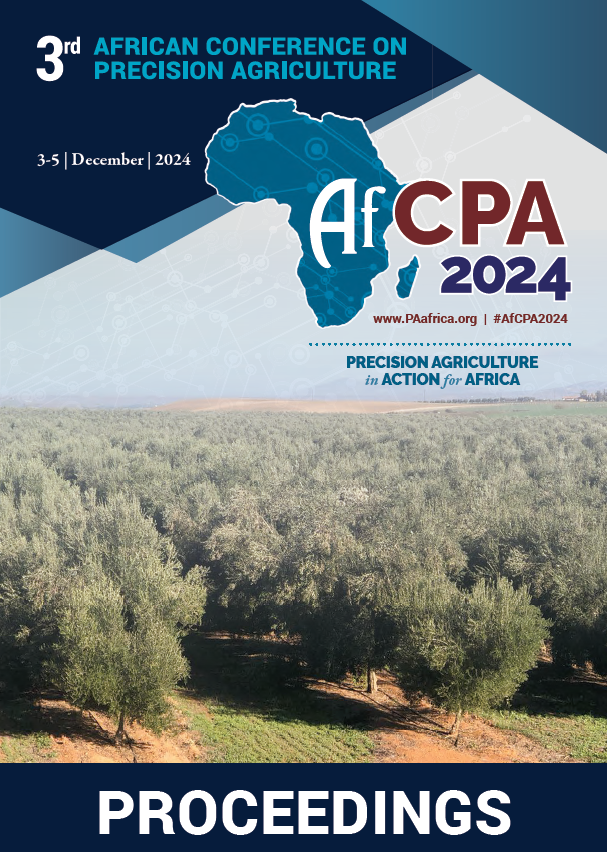
Download the Conference Proceedings
Proceedings
Authors
| Filter results11 paper(s) found. |
|---|
1. Excellence in Agronomy 2030: A new CGIAR-wide initiative to deliver agronomy solutions at scaleRequired increases in crop production and productivity in sub-Saharan Africa (SSA) will not happen without the increased use of appropriate agronomic practices. While several thousand new varieties of nearly all key crops have been produced in the past decade, recent increases in yields in specific countries have only happened when such varieties received the right agro-inputs and management. That said, agronomy is often highlighted as an area that has not delivered impact at scale in SSA, or... B. Vanlauwe, T. Amede, F. Baudron, P. Chivenge, M. Devare, K. Saito, J. Kihara, V. Nangia, P. Pypers, K. Shepherd, E. Vandamme |
2. The Vision of Future Earth Observation for AgricultureThe main objective of EO4AGRI is to catalyze the evolution of the European capacity for improving operational agriculture monitoring from local to global levels based on information derived from Copernicus satellite observation data and through exploitation of associated geospatial and socio-economic information services. EO4AGRI assists the implementation of the EU Common Agricultural Policy (CAP) with special attention to the CAP2020 reform, to requirements of Paying Agencies, and... K. Charvat, V. Safar, H. Kubickova |
3. SmartAfriHub for SmartAgriculture capacity buidling in AfricaDigital Innovation Hubs (DIH) are multi-actor ecosystems that support farming communities in their digital transformation by providing a broad variety of services from a one-stop shop. DIHs purpose is to provide a social space for community of practices; provide access to digital technologies and competencies; provide access to infrastructure and tests digital innovations (“test before invest”); provide development playground... K. Charvat, C. Miderho , A. Obot, T. Löytty, H. Kubickova |
4. Precision Farming Technology to Increase Soil and Crop Productivity in Egypt Using Remote Sensing and GISPrecision farming or site-specific land management is a new approach for development the agriculture processes to increase the soil and crop productivity with saving efforts and costs. Precision farming includes many techniques such as Global Position Systems (GPS), Geographic Information Systems (GIS), Remote Sensing (RS), Yield Monitors, Internet of Things (IOT), Variable Rate Application (VRA), Yield Mapping, Site-Specific Management Zones (SSMZ) and Crop Modeling. SSMZ delineation can be improved... A. Belal, M. Elsayed , M.E. Jalhoum, M. abdelatif , E. Hendawy , M. Emam, M. Zahran |
5. Scaling Precision Agriculture in West Africa Smallholder Irrigation and Water Management SystemsThe advent of precision agriculture (PA) is changing global agricultural productivity; through the underlining principles that ensure inputs required for the management of soil, water and crop agronomy are supplied precisely across the field landscape resulting in optimum yield. The benefits of PA include improved food security through increases in water and nutrient use efficiency, and timely management of good agricultural practices. The practice of PA could be beneficial across commercial –... A.O. Oke, V. Aduramigba-modupe |
6. A review on Sensor based robotics agriculture: Improving traditional Agriculture PracticesAgribot could be a mechanism designed to reduce the labor of farmers by increasing the speed and accuracy of the work. Elementary functions concerned in farming i.e. plowing the sphere, sowing of seeds and covering the seeds with soil. Agribot is associate degree autonomous mechanism that provides the power for choices for offered techniques. Fruit Picker robots, autonomous tractor sprayers, this... S.C. Karad, G.U. Shinde, P. Kumar |
7. Development of Lodging Direction Determination System Using Image ProcessingIn this study, image processing system was developed for application on rice plants to determine lodging condition, which was contributing factor to declining harvester efficiency by using combine harvester. Therefore, We developed a system for determination of the lodging direction by algorithm based on convolutional neural network (CNN). As for deep learning framework, Pytorch1.1.0 were used to train and test the judging direction. GoogLeNet was used as a pre-trained CNN model. Lodging... E. Morimoto, Y. Arai, K. Nonami, T. Ito |
8. Performance agronomique et économique de différentes stratégies de gestion de la fertilité du sol sous culture de soja (Glycine max L. Merril) dans la zone littorale du Togo.Ce travail a pour objectif de valoriser les émondes de deux légumineuses arbustives et quelques fertilisants organiques pour améliorer la production du soja. Afin de parvenir à cet objectif, les paramètres comme la masse de mille graines, les rendements en gousses, en graines, en fanes du soja et autres ont été déterminés. L’étude a eu lieu à la Station d’Expérimentation Agronomique de Lomé (SEAL)... K.M. Amouzouvi, K.E. Ozou, L. Kolani, K.A. Amouzouvi, J.M. Sogbedji |
9. Monitoring Corn (Zea mays) Yield using Sentinel-2 and Machine Learning for Precision Agriculture ApplicationsCurrently, there is a growing demand to apply precision agriculture (PA) management practices at agricultural fields expecting more efficient and more profitable management. One of PA principal components for site-specific management is crop yield monitoring which varies temporally between seasons and spatially within-field. In this study, we investigated the possibility of monitoring within-field variability of corn grain yield in a 22ha field located in Ferarra, North Italy. Archived yield data... A. Kayad, M. Sozzi, F. Pirotti, F. Marinello, L. Sartori, S. Gatto |
10. LiDAR-based soybean crop segmentation for autonomous navigationThe technological advances in the last few decades have greatly changed agricultural operations. In order to became safer, more profitable, efficient, and sustainable, modern farms have adopted the use of sophisticated technologies, such as robots, sensors, aerial images, and GNSS (Global Navigation Satellite System). These technologies not only increase the crop productivity, but also reduce the wide use of water, fertilisers, and pesticides. Due to this, they reduce costs and negative environmental... V.A. Higuti, A.E. Velasquez, M.V. Gasparino, D.V. Magalhães, M. Becker, D.M. Milori, R.V. Aroca |
11. Detecting the Impact of Hail Damage on Maize Crops in Smallholder Farms Using Unmanned Aerial Vehicles Derived Multispectral DataNatural disasters such as hailstorms are now frequent and negatively impact smallholder farmers' livelihoods. In these events, there is a need for robust and innovative techniques for monitoring the extent of their damage in smallholder croplands to optimise production. In this regard, this study sought to evaluate the utility of drone-derived multispectral data in estimating crop health elements (i.e., equivalent water thickness (EWT), chlorophyll content, and leaf area index (LAI) of maize... M. Sibanda |