Download the Conference Proceedings
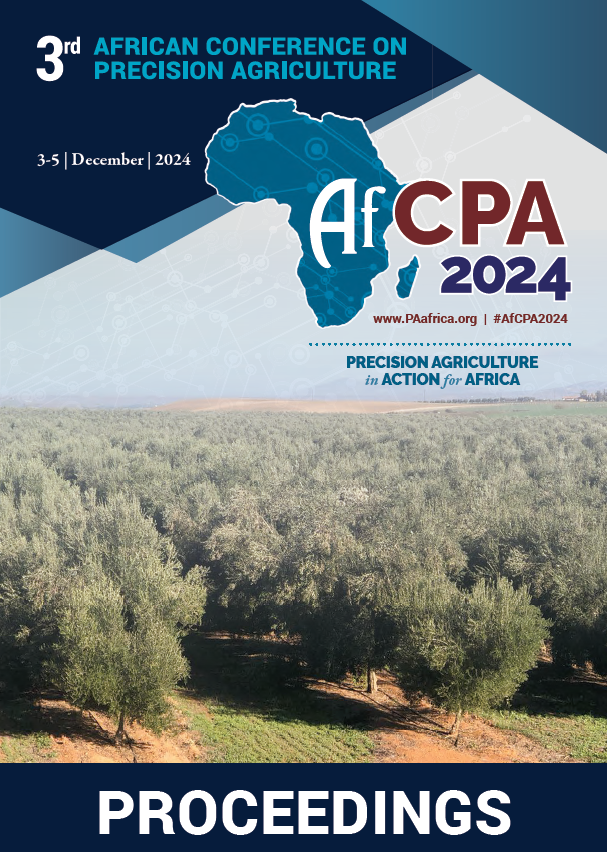
Proceedings
Authors
| Filter results4 paper(s) found. |
|---|
1. Orchard Yield Assessment in North-East of Morocco using Satellite ImageryAgricultural sector represents one of the pillars of the Moroccan economy. The Green Morocco Plan (GMP) established in 2008 present the main engine of development of this sector and for local economy. One of the objectives of Pillar I and Pillar II of GMP was to maximize production with less use of water resources. As an effect of climate change, Morocco is experiencing a strong variability in spatial and temporal variability of precipitation with a detrimental effect on yield and quality of crop... K. Aberkani, A. Matese, S. Samri, M. Said, S. Di Gennaro, P. Toscano |
2. LiDAR-based soybean crop segmentation for autonomous navigationThe technological advances in the last few decades have greatly changed agricultural operations. In order to became safer, more profitable, efficient, and sustainable, modern farms have adopted the use of sophisticated technologies, such as robots, sensors, aerial images, and GNSS (Global Navigation Satellite System). These technologies not only increase the crop productivity, but also reduce the wide use of water, fertilisers, and pesticides. Due to this, they reduce costs and negative environmental... V.A. Higuti, A.E. Velasquez, M.V. Gasparino, D.V. Magalhães, M. Becker, D.M. Milori, R.V. Aroca |
3. Deep Learning is bringing pan-African small holder advisory services based on mid-infrared spectroscopic soil analysis to the next levelThe majority of African smallholder farmers do not have access to soil analytical services. The main reasons are relatively high costs of wet chemical services and difficult logistics. As a result they have to rely on blanket fertilizer recommendations. This often causes poor soil management due to very heterogeneous soil conditions. As a result, the return on investment from blanket fertilizer recommendations is low and fertilizer acceptance is not growing among smallholder farmers. Soil spectral... T. Terhoeven-urselmans, D. Fletcher, M.M. Karanja, J.W. Kamau |
4. Implementing Field-Based High Throughput Plant Phenotyping: The Open Source Way... Y. Kassim |