Download the Conference Proceedings
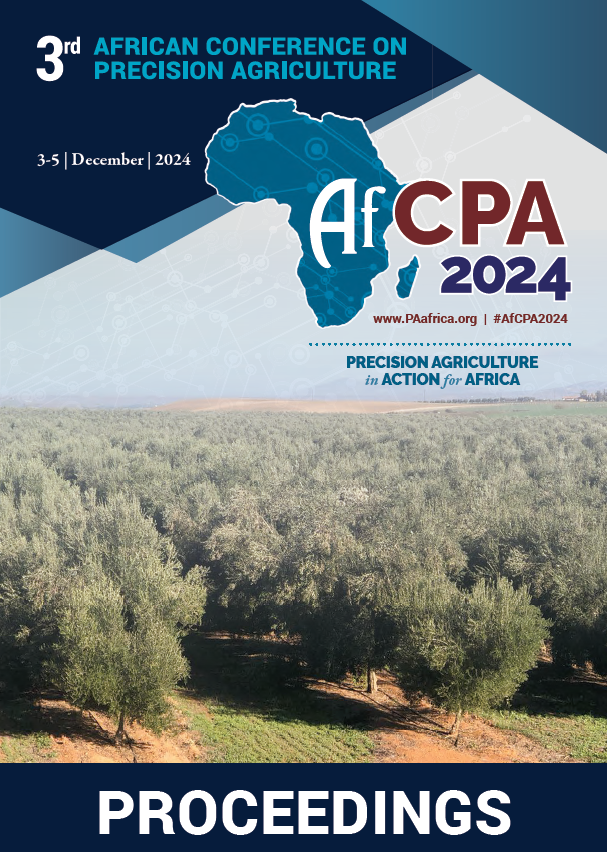
Proceedings
Authors
| Filter results4 paper(s) found. |
|---|
1. Development of Canopy Mapping System of Asian pears (Pyrus pyrifolia Naka) Using Terrestrial Laser ScanningIn this paper, the canopy mapping system (CMS) of Asian pears for estimating yield during Bud thinning and Pruning operations using point cloud data was proposed. Bud thinning and Pruning in Asian pear (Pyrus pyrifolia Naka) is necessary to ensure quality and yield but is time-consuming and heavily depends on work knowledge. This study described a method of estimating the number of fruits through the length of a branch based on remote sensing. The CMS would be useful to support more efficient... E. Morimoto, J. Lee, K. Nonami, I. Matumura, M. Ikebe, S. Sato |
2. Development of Lodging Direction Determination System Using Image ProcessingIn this study, image processing system was developed for application on rice plants to determine lodging condition, which was contributing factor to declining harvester efficiency by using combine harvester. Therefore, We developed a system for determination of the lodging direction by algorithm based on convolutional neural network (CNN). As for deep learning framework, Pytorch1.1.0 were used to train and test the judging direction. GoogLeNet was used as a pre-trained CNN model. Lodging... E. Morimoto, Y. Arai, K. Nonami, T. Ito |
3. Does the combination of conservation agriculture and fertilizer microdosing improve soil chemical properties in semi-arid Zimbabwe in the short term?Crop yields in the fragile semi-arid areas of Zimbabwe have been declining over time due to decline in soil fertility resulting mainly from droughts and lack of fertilizers. However, conservation agriculture (CA) and fertilizer micro-dosing (MD) have the potential to sustainably improve crop yields. A field experiment was set-up to assess the effects of integrating CA and MD on soil quality. It was hypothesized that the two practices improve soil chemical properties (soil organic carbon (SOC),... A. Shumba |
4. A Suitability Approach for Land Assessment of New Reclamation Areas Using GeomaticsThe study aims to develop a system to assess land suitability for agriculture use in the Arid Western Fringes of the Nile Delta. This is based on the fact that the selection of optimal sites for agricultural use is a prerequisite for productive operation and economic feasibility. This is especially true in arid regions due to the scarcity of such suitable land. New approach was implemented to use environmental and terrestrial factors; i.e., criteria of soil characteristics, climate and salinity... A.M. Saleh, S.M. Arafat, M.A. Abdelrahman |