Download the Conference Proceedings
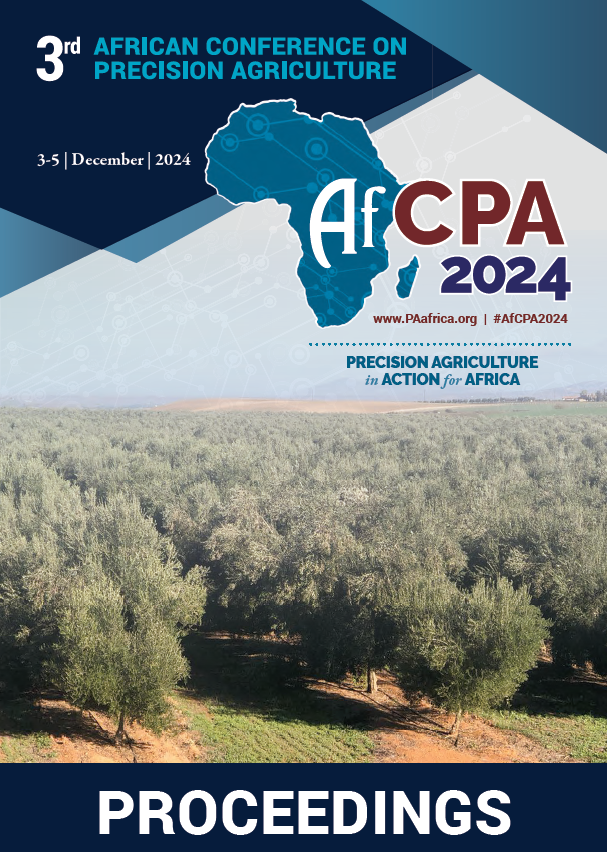
Proceedings
Authors
| Filter results21 paper(s) found. |
|---|
1. Mapping spatial variability of soil nutrient deficiencies in smallholder villages – a prerequisite for improved crop production in AfricaSmallholder farming is the dominating type of agricultural production in many parts of Africa. If cultivation practices can be adapted to match the specific needs of individual smallholder plots, this can certainly be regarded as a form of precision agriculture (PA), considering their limited size. A fundamental prerequisite for successful application of PA is the availability of basic information on soil properties at a detailed enough level. To fill yield gaps, site specific information must... M. Söderström, K. Piikki, J. Kihara, J. Mutua, J. Wetterlind |
2. Assessment of Performance of APSIM Model with Experimental Data from the Short-term Biochar Experiment at Guinea Savanna Zone (Nyankpala), GhanaA three-year season, short-term study (2017–2019) was conducted at farming for the future UDS-Nyankpala, near Tamale in the Guinea Savannah Zone of Ghana. It was done to assess the effect of five different sources of biochar applications on rice-cowpea intercrop system on soil nutrient status and upland rice productivity. The experimental treatments comprised a control, 5 t/ha rates of high and low pyrolysis (400-7000C) of biochar. Five different sources of biochar (groundnut... |
3. Integrating Models and Data to Observe the Effect of Biochar Used in a Rice-Cowpea Intercrop System on Soil Hydrological PropertiesPhysical properties of biochar like small particle size are highly porous and can modify soil properties and help to enhance soil water dynamics. However, there has been no consistent long-term measurements of change in soil physical properties due to biochar application under real field conditions. The objective was to assess the impact of biochar use in a rice-cowpea intercrop system on soil hydraulic properties at the field by integrating a modeling with soil water content measurements in two... |
4. Simulate Plant Growth Response to Biochar applications on upland rice-cowpea intercrop and Inorganic N and P on a Ferric luvisols Soil in GhanaFive different sources of biochar (groundnut shells, rice husk, poultry manure, sawdust, and corn cobs) at a rate of 5t/ha were incorporated into the soil at a depth of 30 cm during field experiments in Nyankpala in Ghana. A split plot factorial design arranged in a randomized complete block with 4 replications was used. The uniqueness of the studies was that cowpea and inorganic fertilizer treatments were added to aid upland rice-cowpea N and P content of the biochar. These studies provide a... |
5. REVISITING INLAND VALLEYS MANAGEMENT STANDARDS IN THE CONTEXT OF GLOBAL CHANGE IN WEST AFRICAConsidered as main alternative to the crisis of traditional production systems, inland valleys management pains more and more to fill expectations of West African’s farmers due to the inadequacy, in the current context of climate, agrarian and environmental change of the management standards applied to these ecosystems. One consequence of this inadequacy is the inefficient exploitation of the inland valleys with the results being the persistence of the food insecurity, environmental degradation... A. Tidjani, P. Tovihoudji |
6. Development of Canopy Mapping System of Asian pears (Pyrus pyrifolia Naka) Using Terrestrial Laser ScanningIn this paper, the canopy mapping system (CMS) of Asian pears for estimating yield during Bud thinning and Pruning operations using point cloud data was proposed. Bud thinning and Pruning in Asian pear (Pyrus pyrifolia Naka) is necessary to ensure quality and yield but is time-consuming and heavily depends on work knowledge. This study described a method of estimating the number of fruits through the length of a branch based on remote sensing. The CMS would be useful to support more efficient... E. Morimoto, J. Lee, K. Nonami, I. Matumura, M. Ikebe, S. Sato |
7. Nutrient management tailored to smallholder agriculture enhances productivity and sustainabilityPlant nutrition plays a central role in the global challenge to produce sufficient and nutritious food, lessen rural poverty, and reduce the environmental footprint of crop production. Efficient fertilizer use requires tailored solutions that are scientifically sound, practical and scalable especially for smallholder farmers, such as the crop-led site-specific nutrient management (SSNM) approach developed in the 1990s for cereal production systems in Asia to address variability among farms. Originating... P. Chivenge, K. Saito, M. Bunquin, S. Sharma, A. Dobermann |
8. Determining Nutrients rates for Maize, Rice, Cotton, and Tomato in Dry Savannah zone of Togo based on site specific nutrient management approachInadequate fertilizer application limits crop yields and lead to the soil fertility depletion. This study aims at formulating nutrients rates recommendations for main the crops in dry savannah zone of Togo. Site specific nutrient management approach based on spatial variations in nutrients status, crops nutrients requirement and average crop yields under field conditions was used to determine recommendations rates in N, P and K. For maize cropping, nutrients needs are 94 kgN.ha-1, 42... |
9. Application of precision agriculture technologies in grazing: example of goats browsing in forest rangelands of Northern MoroccoThe aim of this study was to characterize patterns of grazing behavior of goats in a Mediterranean forest rangeland. We conducted a one-year study in the Chefchaouen region, Northern Morocco, during two contrasting seasons (spring and summer) using new technological tools. Eight goats were simultaneously fitted with GPS collars and sensors for 3 days during each season. A calibration study and classification tree analysis were used to predict other grazing activities of goats (eating, walking,... Y. Chebli, S. El otmani, M. Chentouf, J. Hornick, J. Cabaraux |
10. Development of Lodging Direction Determination System Using Image ProcessingIn this study, image processing system was developed for application on rice plants to determine lodging condition, which was contributing factor to declining harvester efficiency by using combine harvester. Therefore, We developed a system for determination of the lodging direction by algorithm based on convolutional neural network (CNN). As for deep learning framework, Pytorch1.1.0 were used to train and test the judging direction. GoogLeNet was used as a pre-trained CNN model. Lodging... E. Morimoto, Y. Arai, K. Nonami, T. Ito |
11. Analysis, design and development of a web and mobile application for fertilizer olive orchards recommendationsFarmer’s fertilization practices (FFP) in olive intensive or super intensive orchards must be improved to a better control of fertilization costs, to increase olive yielding, to maintain soil fertility and to avoid environment pollution. Indeed, a large category of fertilizer users apply fertilizers arbitrary (66%) without any knowledge about the adequate nutrient requirements of a such planting system. To improve the FFP in intensive and super intensive olive orchards, and in the frame... A. Larbi, H. Boulal, H. El arbi, W. Ben hamouda |
12. Soil fertility characterization and mapping for Adigudem plain, Northern EthiopiaAs Ethiopia’s agriculture has been influenced by variability and poor soil fertility management and information, thus this study was aimed to determine the physico-chemical properties of soils and build geo-referenced soil information systems so as to have precision agriculture for adigudem plain. An area of 229 km2 comprising different villages was delineated for the study. Soil sampling points were arranged in a grid form and georeferenced using a hand-held GPS. A total of 194 Soil samples... G. Berhe |
13. Keynote 6 - Farmer-led design and knowledge sharing: Empowering smallholders to maximize impactProducers Direct is an international non-profit led by smallholder farmers for smallholder farmers. With over a decade of experience in farmer-led design and experimentation, Producers Direct has piloted and scaled a number of in-person and digital solutions that have improved the livelihoods for over 1 million small-scale farmers across East Africa and Latin America to-date. International recognition for our work has included UK Google Impact Challenge winner; World Bank Collaborative Data... C. Rhodes |
14. Drivers of Post-harvest Aflatoxin Contamination: Evidence Gathered from Knowledge Disparities and Field Surveys of Maize Farmers in the Rift-valley Region of KenyaMaize-dependent populations in sub-Saharan Africa are continually exposed to aflatoxin poisoning owing to their regular consumption of this dietetic cereal. Being a staple in Kenyan households, consumption of maize-based meals is done almost daily, thereby exposing consumers to aflatoxicoses. This study assessed awareness levels, knowledge disparities and perceptions regarding aflatoxin contamination at the post-harvest phase among farmers in the Rift-valley region of Kenya. Households were randomly... G.W. Gachara, R. Lahlali, R. Suleiman, B.M. Kilima |
15. Assessment of Nitrogen and Phosphorus Content (NP) in Citrus Trees Using UAV-imagery Derived Vegetation Indices and Machine Learning AlgorithmsMonitoring nutrient status of citrus trees is fundamental to ensure optimum fruit yield and quality. However, this task is traditionally time-consuming and laborious. Unmanned Aerial Vehicles (UAVs), with their high temporal and spatial resolution imagery, are demonstrating a great potential to substitute traditional methods in assessing nutrient status of several crops, including citrus. In this study, we evaluated the performance of vegetation indices (VIs) derived from UAV multispectral images... Z. Abail, H. Benaouda, M. Chikhaoui, H. Benyahia, O. Iben halima, M. Baraka, A. Douaik, H. Iaaich, A. Zouahri, F. Omari |
16. Effect of Different Combinations of N, P and K Nutrients on Growth, Yield and Fibre Quality of Cotton (Gossypium Hirsutum L.)Cotton has high requirements for nitrogen (N) phosphorus (P) and potassium (K), and the nutrients interact differently on yield and quality of this crop. This necessitates the precise combination of these nutrients to maximize yield and quality. Two cotton varieties (Bt cotton and a conventionally bred variety, HART 89M) were assessed for growth, yield and quality under different nutrient combinations in two contrasting environments in semi-arid Kenya. Nutrient combinations were NPK,... E.W. Maina, E.W. Maina |
17. Unmanned Aerial Vehicles (UAVs) for Phenotypic Traits Estimation & Yellow Rust Disease Severity Assessment in Small-scale Wheat Breeding Trials in EthiopiaRemote Sensing (RS) platforms; like the Unmanned Aerial Vehicles (UAVs) are recently gaining traction in agricultural data collection systems and used for various phenotyping of breeding field trials and capturing different biophysical, biochemical and sanitary traits which can be used to predict and explain the resulting yield and selecting better verities. Compared to the conventional phenotyping usually done by visual scoring and manual measurements which is time consuming/back breakings, susceptible... T. Anberbir, G. Mamo , A. Dabi |
18. Using Precision Technologies to Monitor the Grazing Activities of Goat in a North African WoodlandIn the north of Africa, browsing on natural pastures is the main source of feed for domestic goats. Livestock farming, particularly grazing goats, constitutes the prevalent agricultural activity in the mountainous areas of Morocco. Data on animal behavioral activities are essential for understanding their feeding and their interaction with the environment in order to define the optimal management intervention strategies. The recent development of precision farming technologies and the increasing... Y. Chebli, M. Chentouf, J. Cabaraux, S. El otmani |
19. Farmer-led Approaches to Digital InnovationDigital agricultural innovation has significant potential to transform the ability of smallholder farmers to engage with and benefit fro precision agriculture. Despite this, the benefits of digital agricultural technologies remain largely inaccessible to most of these smallholder farmers. This presentation will share updates and lessons learnt from Producers Direct’s experiences in designing and scaling farmer-led approaches to digital agricultural innovation. ... C. Rhodes |
20. Evaluating Soil Organic Matter Under a No-Till System Using Digital Sensors (EM38 and MSP3)Agriculture, especially in no-till systems, plays a crucial role in ensuring global food security. The pressure on agricultural lands due to a growing population and climate change necessitates innovative solutions. Proximal soil sensing using electromagnetic induction (EMI) and electrical conductivity (ECa) sensors has gained prominence. These technologies provide rapid, non-destructive measurements of soil properties, offering advantages over remote sensing and laboratory analyses. In... H. Hajjaj, K. Ibno namr, E. Abdellah , C. El khalfi |
21. Design and Development of a LoRa Communication System for Scalable Smart Irrigation SystemsSmart irrigation is a promising tool to optimize irrigation water use but is still faced with challenges related to usability and applicability attributed to several constraints such as high initial costs, complex user interface, poor connectivity, limited farm coverage, etc. This study aimed to solve some of these issues through the development and testing of a LoRa communication system using a Raspberry Pi 4, LoRa HAT concentrator, and Strega smart valve at the Makerere University Agricultural... J. Wanyama , J. Ikabat, I. Kabenge, P. Hess, P. Nakawuka, E. Bwambale , J. Muyonga, S. Felicioni, A. Bühlmann, T. Anken |
