Download the Conference Proceedings
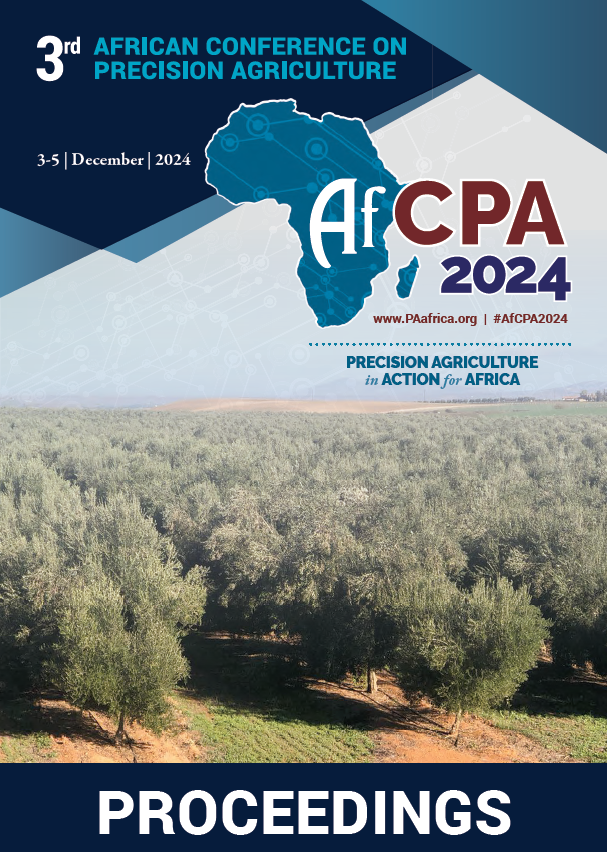
 
Get your copy of the 2024 African Conference on Precision Agriculture Proceedings today! Download the PDF file and view all of the available proceedings.
AfPCA Proceedings 2024

Proceedings

Find matching any: Reset
Shaibu, I
Singh, P
Kamutando, C.N
SATO, S
Gerard , B
Abban-Baidoo, E
Njoroge, S
Kenea, W.B
Agbemabiese, Y.K
Peña, J
Add filter to result:
Authors
Abban-Baidoo, E
Shisanya , C.A
Macharia, A.N
Frimpong, K.A
Marschner, B
MORIMOTO, E
LEE, J
NONAMI, K
MATUMURA, I
IKEBE, M
SATO, S
Crouch, J
Shephard, K
Miller, M
Collinson, J
Singh, P
Pypers, P
van den Bosch, R
van Beek, C
Chernet, M
Aston, S
Agbemabiese, Y.K
Abubakari, P
Dzomeku, P.K
Shaibu, I
Kenea, W.B
Tura, T.B
Woldekristos, A.N
choukri, M
Laamrani , A
simonneaux , V
Gerard , B
Belaqziz, S
Chehbouni, A
misbah, K
Mcnairn, H
Peña, J
de Castro, A
Chinwa, H
Kamutando, C.N
Topics
Precision Nutrient Management
Precision Agriculture for Field and Plantation Crops
Plenary
Precision Water Management
Precision Nutrient Management
Mapping and Geostatistics
Plenary Session
Climate Smart Agriculture
Type
Poster
Oral
Year
2020
2022
2024
Home » Authors » Results

Authors

Filter results8 paper(s) found.

1. Biochar and/or Compost for Soil Quality and Maize Yield Improvement in an Acidic Ferralsol Soil in Kenya.

The rapidly increasing global population, climate change and dwindling resources have made it very difficult to meet global food demand. To address the issue of food insecurity, sustainable intensification of agriculture (SIA) has been proposed. However, the consequences of poorly managed agricultural intensification can negatively affect the ecosystem. Biochar and compost application has been widely recommended as a highly promising soil fertility replenishment option to promote sustainable agriculture....

2. Development of Canopy Mapping System of Asian pears (Pyrus pyrifolia Naka) Using Terrestrial Laser Scanning

In this paper, the canopy mapping system (CMS) of Asian pears for estimating yield during Bud thinning and Pruning operations using point cloud data was proposed. Bud thinning and Pruning in Asian pear (Pyrus pyrifolia Naka) is necessary to ensure quality and yield but is time-consuming and heavily depends on work knowledge. This study described a method of estimating the number of fruits through the length of a branch based on remote sensing. The CMS would be useful to support more efficient... E. Morimoto, J. Lee, K. Nonami, I. Matumura, M. Ikebe, S. Sato

3. Mapping African soils at 30m resolution - iSDAsoil - Western Time Zones

“iSDAsoil” combines remote sensing data and other geospatial information with carefully stratified point samples subjected to spectral analysis and traditional wet chemistry reference analysis. State of the art machine learning techniques were used to create digital maps of 17 agronomically important soil properties at 3 depths, including estimates of uncertainty. iSDAsoil is designed to encourage sharing and we hope that the owners of other soil and agronomic data, in industry... J. Crouch, K. Shephard, M. Miller, J. Collinson, P. Singh, P. Pypers, R. Van Den Bosch, C. Van Beek, M. Chernet, S. Aston

4. Modelling Fertigation and Micro-Climate Parameters for Greenhouse Tomato (Solanum Lycopersicum L.)

Amidst the hiking price of fertilizer and projected water scarcity across the world, it is imperative to explore the interaction between fertilizer, irrigation and genotype notwithstanding the micro-climate parameters so as to maximize yield while protecting the environment. The Decision Support System for Agrotechnology Transfer (DSSAT) is a model which employs all these input factors to help predict yield and thereby make an informed decision.  The study sort to calibrate and validate the... Y.K. Agbemabiese, P. Abubakari, P.K. Dzomeku, I. Shaibu

5. Precision Maize Nutrition: Evidences from On-farm Experimentation of Quefts Estimated Nutrient Requirement for Variable Densities in Smallholder Farmers in Ethiopia

Quantitative Evaluation of the Fertility of Tropical Soils (QUEFTS) model is an important tool for estimating optimal nutrient requirement of crops. The study was conducted to evaluate QUEFTS estimated (QE) nutrient requirement of maize in two pant densities (32,443 and 53,333 plants/ha in Central Rift Valley (CRV); 27724 and 62,000 plants/ha in Jimma) on fields of three farmers wealth classes (poor, medium and wealth) in contrasting agro-ecologies of Ethiopia. QUEFTS follows a target oriented... W.B. Kenea, T.B. Tura, A.N. Woldekristos

6. Use of Earth Observation Imagery, Advanced Modelling Algorithms and Other Monitoring Systems to Produce Operational Agricultural Annual Crop Inventories for Morocco.

African farmers are facing the challenges of a changing climate, increased temperatures, changes in rainfall patterns, more frequent extreme weather events and reductions in water availability. The digital transformation of the agricultural sector is one of the opportunities that can promote good practices of the African agricultural through  the sharing of information and tools for decision-making, thereby, boost economic growth of our African country. The shift to digital technologies is... M. Choukri, A. Laamrani , V. Simonneaux , B. Gerard , S. Belaqziz, A. Chehbouni, K. Misbah, H. Mcnairn

7. A Multi-scale Evaluation of Precision Weed Control Strategies in Corn Fields with Drone Technology

Corn (Zea mays L.) is a worldwide priority crop, whose potential yields are closely affected by weed competence, especially in the early stages of crop development. A major concern in corn-growing areas is the occurrence of Sorghum halepense L., as this weed shows reduced sensitivity to pre-emergence herbicides and, therefore, it is necessary to use post-emergence treatments that entail an increase in cost. This research studied the impact of applying a precision weed (S.... J. Peña, A. De Castro

8. Predicting the Distribution of Groundnut Phytopathogens Under Current and Future Climatic Scenarios in Zimbabwe

Groundnut (Arachis hypogaea L.) is an important oil crop with immense nutritional and economic benefits, but its productivity in sub-Saharan Africa (SSA) is threatened by a plethora of phytopathogens such as groundnut rosette virus, Alternaria leafspots, early leafspots and peanut rust. In Zimbabwe, ecological niches and epidemiology of these pathogenic microbial strains, particularly under the current and predicted climate change scenarios, are still poorly understood. Yet, this information... H. Chinwa, C.N. Kamutando