Download the Conference Proceedings
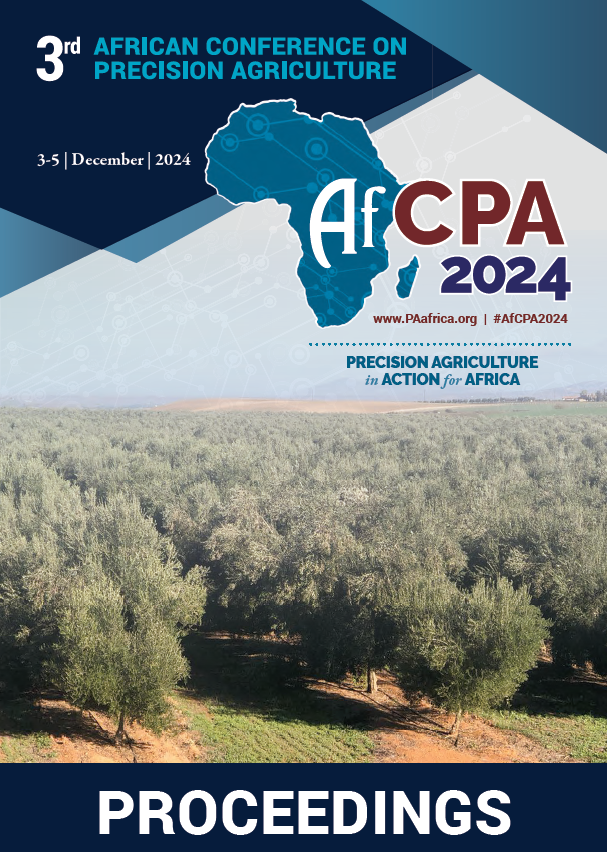
 
Get your copy of the 2024 African Conference on Precision Agriculture Proceedings today! Download the PDF file and view all of the available proceedings.
AfPCA Proceedings 2024

Proceedings

Find matching any: Reset
LACHGAR , A
Lowenberg-DeBoer, J
Lesueur, C
Persson, K
Peña, J
Lin, S
Add filter to result:
Authors
Biswas, A
Fu, Y
Taneja, P
Lin, S
Daggupati, P
Vasava, H
LACHGAR , A
Lowenberg-DeBoer, J
Söderström, M
Persson, K
Peña, J
de Castro, A
Frimpong, K
FASSINOU HOTEGNI, V
Karangwa, A
Manyatsi, A
Amri, M
Cammarano, D
Lesueur, C
Taylor, J
Phillips, S
Achigan-Dako, E.G
HOUESSOU, G
LINKPON, O
Tchokponhoué, D
Houdegbe, C
ADJE, C
Topics
Proximal and Remote Sensing
Precision Nutrient Management
Keynote
Proximal and Remote Sensing
Plenary Session
Education and Engagement in Precision Agriculture
Type
Oral
Year
2020
2022
2024
Home » Authors » Results

Authors

Filter results6 paper(s) found.

1. Estimating soil organic carbon from cell phone images

Soil organic matter (SOM) is considered as the backbone of soil health and soil quality. Thus, its’ estimation is critical to support the development of management decision including precision agriculture. To overcome challenges of laborious, rather expensive and time-consuming laboratory measurements, recent advances in image acquisition systems provided a new dimension of image-based SOM prediction. However, challenges remain in using soil images taken directly in the field due to variable... A. Biswas, Y. Fu, P. Taneja, S. Lin, P. Daggupati, H. Vasava

2. Implementation of Proximal Soil Sensing, Data Fusion and Machine Learning to Improve Phosphorus Management at a Field Scale

In the context of a rapid increase in phosphorus (P) fertilizers prices, new techniques are needed for geospatial predictions of soil P for improved P fertilizer management, while increasing farmer profitability and reducing environmental concerns. One of the biggest issues in site-specific phosphorus management is the substantial spatial variability in plant available P across fields. This leads to an expensive and laborious process for accurate mapping soil P using a traditional soil sampling... A. Lachgar

3. Keynote 3 - Setting the Record Straight on Precision Agriculture Adoption

Adoption of precision agriculture (PA) around the world has been uneven. Some PA technologies have been the most rapidly adopted agricultural technologies in history and others have lagged. Among the disappointments is variable rate fertilizer, which was among the first PA technologies, but has become standard practice only for some farming niches. PA is a tool box – Farmers take the tools that they need and leave the rest. For example, in countries with mechanized... J. Lowenberg-deboer

4. From Drone to Satellite – Does It Work?

Multispectral drone-sensors are useful for detailed studies of crop characteristics in field trials, e.g. to create prediction models on nitrogen (N) uptake, or even estimates of optimal N rate to apply. To enable wide application of such models, they may be applied in satellite image-based decision support systems for farmers. However, successful transfer of models based on spectral data from one platform to another, requires strong and stable correlation between data from the different sensors.... M. Söderström, K. Persson

5. A Multi-scale Evaluation of Precision Weed Control Strategies in Corn Fields with Drone Technology

Corn (Zea mays L.) is a worldwide priority crop, whose potential yields are closely affected by weed competence, especially in the early stages of crop development. A major concern in corn-growing areas is the occurrence of Sorghum halepense L., as this weed shows reduced sensitivity to pre-emergence herbicides and, therefore, it is necessary to use post-emergence treatments that entail an increase in cost. This research studied the impact of applying a precision weed (S.... J. Peña, A. De castro

6. Capacity Building of African Young Scientists in Precision Agriculture Through Cross Regional Academic Mobility

Climate change is one of the main problems affecting food and nutrition globally, particularly in sub-Saharan Africa. Adapting to and/or mitigating climate change in the agri-food sector requires merging information technologies, genetic innovations, and sustainable farming practices to empower the agricultural youth sector to create effective and locally adapted solutions. Precision Agriculture applied to crops (PAAC), has been advocated as a strategic solution to mitigate/adapt agriculture at... K. Frimpong, V. Fassinou hotegni, A. Karangwa, A. Manyatsi, M. Amri, D. Cammarano, C. Lesueur, J. Taylor, S. Phillips, E.G. Achigan-dako, G. Houessou, O. Linkpon, D. Tchokponhoué, C. Houdegbe, C. Adje