Download the Conference Proceedings
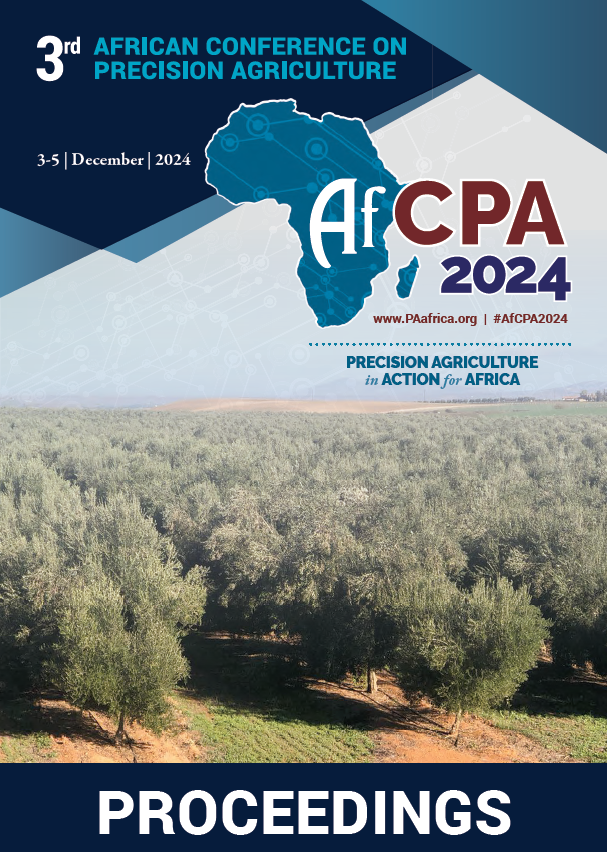
 
Get your copy of the 2024 African Conference on Precision Agriculture Proceedings today! Download the PDF file and view all of the available proceedings.
AfPCA Proceedings 2024

Proceedings

Find matching any: Reset
Mirkena, L.W
Ogunkunle, A
Woldekristos, A.N
LEBRINI, Y
Ojambo, E
SOGBEDJI, M.J
Goshu, T.A
Adesina, F.A
Sapkota, T
Durojaiye, A.M
Kouassi, K
Toscano, P
Abdul Rashid, I
KPEMOUA , K.E
Add filter to result:
Authors
LARE, M
SOGBEDJI, M.J
Denton, O.A
Ogunkunle, A
Aberkani, K
Matese, A
Samri, S
Said, M
Di Gennaro, S
Toscano, P
KOUDJEGA, K
GANYO , K.K
ABLEDE, .A
ANI , S.E
AFAWOUBO , K
ANOUMOU , D
ASSIH-FARAM,
MENSAH , A
TCHALLA-KPONDI,
KPEMOUA , K.E
LOMBO , Y
Awosiyan, O.E
Mary, I.K
Adesina, F.A
Sapkota, T
Cheerakkollil Konath, N
Takele, R
Snapp, S
Geremew, N.T
Waraka, B.B
Mirkena, L.W
LEBRINI, Y
AYERDI-GOTOR, A
Kenea, W.B
Tura, T.B
Woldekristos, A.N
Goshu, T.A
Goshu, T.A
Goshu, T.A
Kassim, Y
Richard Oteng-Frimpong, R
Kanvenaa Puozaa, D
Kofi Sie, E
Abdul Rasheed, M
Abdul Rashid, I
Danquah, A
A. Akogo, D
Rhoads, J
Hoisington, D
D. Burow, M
Balota, M
Kenea, W
Woldekristos, A.N
Balemi, T
Toviho, J
Brou, I.E
Kouassi, K
Fadairo, O
Durojaiye, A.M
Adegbayi, R
Topics
Precision Agriculture for Field and Plantation Crops
Mapping and Geostatistics
Satellite Imagery
Precision Nutrient Management
On-Farm Experimentation
Proximal and Remote Sensing
Climate Smart Agriculture
Small Holders and Precision Agriculture
Decision Support Systems, Software and Mobile Applications
Type
Oral
Poster
Year
2020
2022
2024
Home » Authors » Results

Authors

Filter results14 paper(s) found.

1. Maximisation de l’efficience d’utilisation de l’azote par la tomate(Solanum lycopersicum L.) sur les ferrasols au Sud du Togo

Maximiser l'efficience d'utilisation de l'Azote (N) en culture de tomate s'impose pour améliorer le rendement et la rentabilité de la culture. Il a été mené sur trois ans, six cultures de tomate réparties sur deux périodes (septembre à janvier 2017-2019 et de février à mai 2018-2020) sur un sol ferralitique à la Station d'Expérimentations Agronomiques de Lomé suivant un dispositif expérimental... M. Lare, M.J. Sogbedji

2. LAND DEGRADATON RISK ASSESSMENT AT A SITE IN AFIJIO LOCAL GOVERNMENT AREA OF OYO STATE, NIGERIA

Soils are considered non –renewable and it is a limited resource therefore the continuous use of land without appropriate management practices leads to land degradation in the long run. Land degradation is the decline in soil quality caused by natural factors or, more often, by improper use/management usually for agricultural, pastoral or urban purposes. This study aims to map the soils while also assessing the state of land degradation in Afijio Local government area of Oyo state. The study...

3. Orchard Yield Assessment in North-East of Morocco using Satellite Imagery

Agricultural sector represents one of the pillars of the Moroccan economy. The Green Morocco Plan (GMP) established in 2008 present the main engine of development of this sector and for local economy. One of the objectives of Pillar I and Pillar II of GMP was to maximize production with less use of water resources. As an effect of climate change, Morocco is experiencing a strong variability in spatial and temporal variability of precipitation with a detrimental effect on yield and quality of crop... K. Aberkani, A. Matese, S. Samri, M. Said, S. Di gennaro, P. Toscano

4. Determining Nutrients rates for Maize, Rice, Cotton, and Tomato in Dry Savannah zone of Togo based on site specific nutrient management approach

Inadequate fertilizer application limits crop yields and lead to the soil fertility depletion. This study aims at formulating nutrients rates recommendations for main the crops in dry savannah zone of Togo. Site specific nutrient management approach based on spatial variations in nutrients status, crops nutrients requirement and average crop yields under field conditions was used to determine recommendations rates in N, P and K. For maize cropping, nutrients needs are 94 kgN.ha-1, 42...

5. DIGITAL MAPPING OF EXCHANGEABLE CATIONS IN SOILS OF SOUTHWESTERN NIGERIA

Soil acidity and low exchangeable cation are the major soil fertility challenges resulting in low crop productivity in Southwest Nigeria. Digital soil mapping is an effective way to achieve precision agriculture. However, most of the research work on soil exchangeable cations as soil information was not geo-referenced, The study created geo-database and developed a digitized map of soil exchangeable cations Indicating the spatial distribution in soils of southwestern Nigeria. Secondary data... O.E. Awosiyan, I.K. Mary, F.A. Adesina

6. Fighting Food, Fertilizer, and the Climate Crisis in Africa Through Targeted Nitrogen Management

Food insecurity is a major challenge in Africa which is likely to worsen in the future unless food production in the region is substantially increased to keep up with the food demand of the increasing population. A sufficient amount of nitrogen (N) fertilizer is required for increasing crop yield as N helps convert solar radiation into carbohydrates that drive plant growth.  However, smallholder producers in Africa use a small quantity of fertilizer N not sufficient for plant needs resulting... T. Sapkota, N. Cheerakkollil konath, R. Takele, S. Snapp

7. Lime and Phosphorus Effects on Soil Acidity and Malt Barley Phosphorus Use Efficiency in Welmera District, Central Highlands of Ethiopia

In Ethiopia, about 43% of total arable land affected by soil acidity. Furthermore, phosphorus (P) deficiency is a major constraint to increase crop yields. Efforts to ameliorate the deleterious effects of soil acidity must therefore be accompanied by measures to increase P availability in soils. Therefore, appropriate rate of lime and P fertilizer is an important strategy for improving crop growth in acidic soils. Accordingly, an experiment was undertaken to study lime and P effects on soil acidity... N.T. Geremew, B.B. Waraka, L.W. Mirkena

8. Performance of Remote Sensing Data and Machine Learning for Wheat Disease Detection

The use of agrochemicals has many impacts on humans’ health and generates many environmental issues. However, a suitable management of agrochemicals inputs, such as insecticides, fungicides, and herbicides, is crucial to the success of wheat crops under climate change conditions. The use of remote sensing technologies in agriculture was raised within the technological evolution of materials and techniques during last decades. The development of new and cheap sensors has been the main reason... Y. Lebrini, A. Ayerdi-gotor

9. Precision Maize Nutrition: Evidences from On-farm Experimentation of Quefts Estimated Nutrient Requirement for Variable Densities in Smallholder Farmers in Ethiopia

Quantitative Evaluation of the Fertility of Tropical Soils (QUEFTS) model is an important tool for estimating optimal nutrient requirement of crops. The study was conducted to evaluate QUEFTS estimated (QE) nutrient requirement of maize in two pant densities (32,443 and 53,333 plants/ha in Central Rift Valley (CRV); 27724 and 62,000 plants/ha in Jimma) on fields of three farmers wealth classes (poor, medium and wealth) in contrasting agro-ecologies of Ethiopia. QUEFTS follows a target oriented... W.B. Kenea, T.B. Tura, A.N. Woldekristos

10. Effects of Legume Break Crops on Yield, Nitrogen Use Efficiency and Economy of Maize Production in Western Oromia, Ethiopia: a Review

Prolonged monocropping of maize lacking appropriate soil fertility management is affecting soil fertility and maize production in Western Oromia. The use of legume break crops improved performance of subsequent maize. The biological N2-fixation of legumes as precursor crops reduced the amount of nitrogen fertilizer applied to maize. Higher mean grain yield of maize was obtained following faba bean without and with rhizobia inoculation than maize after maize. The total nitrogen uptake of different... T.A. Goshu, T.A. Goshu, T.A. Goshu

11. Implementing Field-Based High Throughput Plant Phenotyping: The Open Source Way

... Y. Kassim

12. Sustainability of Maize Production with Farmers’ Practices and Redesigned Crop Management Practices in CRV and Jimma of Ethiopia

Multi-criteria assessment of crop management practices is vital for sustainable crop production and environmental safety. In this study, sustainability of maize production with farmer’s practice (FP), redesigned plant density plus current fertilizer use (RDCF), current plant density plus redesigned fertilizer use (CDRF), and redesigned plant density and redesigned fertilizer use (RDRF) were assessed at farm level based on social, agronomic, economic and environmental principles in Central... W. Kenea, A.N. Woldekristos, T. Balemi

13. Empower Farmers to Sustainably Agricultural Productivity in West Africa: FeSeRWAM, a Digital Advisor for Farmers

Many smallholder farmers in West Africa have a common challenge which is their inability to access the right information on appropriate agricultural inputs and practices to unlock existing potential, make better decisions and get more dividends on their investments. Supported by USAID, Feed the Future "Enhancing Growth through Regional Agricultural Input Systems (EnGRAIS/IFDC) and Partnership for Agricultural Research, Education and Development (PAIRED) have developed and deployed an... J. Toviho, I.E. Brou, K. Kouassi

14. Use of Digital Extension Tools for Agricultural Information Management Among Cassava Value Chain Actors in Ibadan Metropolis, Oyo State, Nigeria

Poor coverage of farmers by extension services and other limitations necessitates adapting the agricultural process to new opportunities, including digital extension. This is more important for cassava value chain actors given the recognition of the crop for food security in Nigeria and its widespread promotion by several local and regional development interventions.  Therefore, the use of digital extension tools for agricultural information management among cassava value chain actors in... O. Fadairo, A.M. Durojaiye, R. Adegbayi